
Jaw pain can be surprisingly hard to pin down. It might feel like a dull ache near your ear, a clicking sound when you chew, or tension that spreads toward your temple. The jaw joint, surrounding muscles, neck, stress levels, and dental health can all play a role.
The right treatment depends on understanding what is actually driving the pain. Here is what to know.
If you are already looking for care, Dr. Natalie Lopez offers jaw pain and TMJ treatment in Mississauga at Tip Top Health.
Common causes of jaw pain
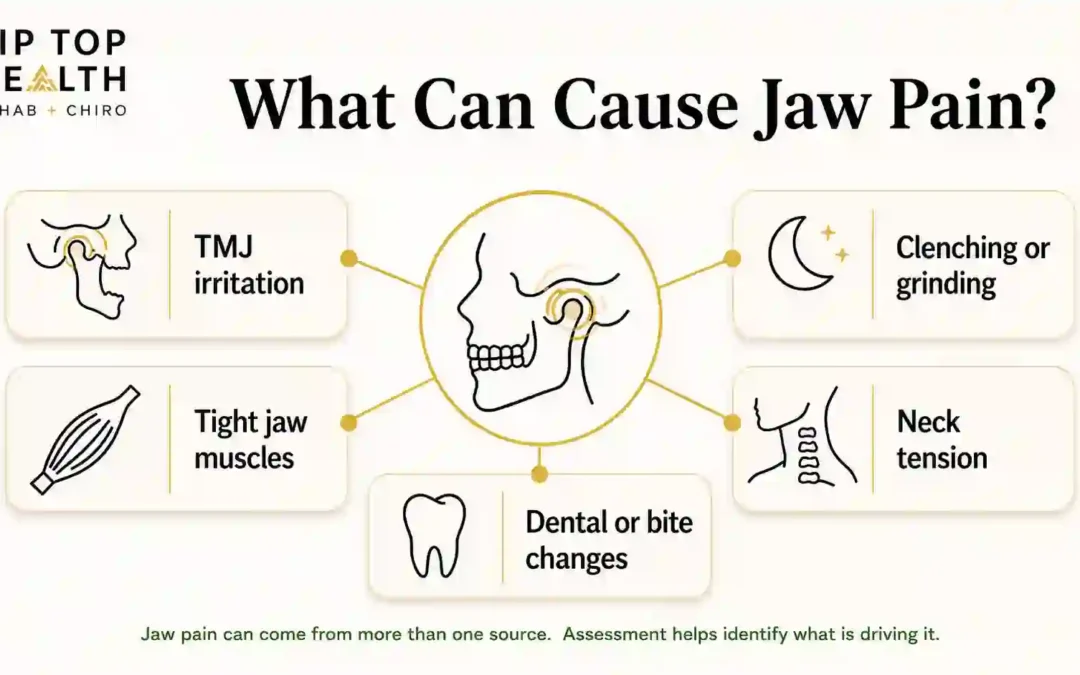
Jaw pain can come from several structures and habits. Common causes include:
- TMJ irritation or poor jaw tracking. The temporomandibular joint (TMJ) is the hinge that connects your jaw to your skull. When it is irritated or not moving smoothly, it can cause pain, clicking, or a feeling of the jaw catching.
- Clenching or grinding. Many people clench or grind their teeth at night without realizing it. This puts sustained pressure on the jaw muscles and joint, often resulting in morning soreness.
- Tight jaw muscles. The masseter (the muscle you feel when you clench your jaw), temporalis (along the side of your head), and smaller muscles inside the jaw can all become tense and sore.
- Neck tension and upper cervical involvement. The jaw and upper neck share muscle connections and nerve pathways. Tension in the neck can change how the jaw moves and feels.
- Dental work or bite changes. Recent dental procedures, new fillings, or changes to how your teeth fit together can temporarily affect the jaw.
- Injury or trauma. A direct impact to the jaw or head can strain the joint and surrounding tissues.
- Stress-related muscle tension. When you are stressed, you may unconsciously tighten your jaw, leading to accumulated tension over time.
If you suspect a dental cause such as tooth decay, gum problems, or a bite issue, it is best to start with a dentist. A dentist can rule out oral health issues first.
Why jaw pain can feel like ear pain, headaches, or neck tension
The jaw, upper neck, temples, and ear-area structures are close together. Tension in one area can refer pain to another. Jaw muscle tightness can create aching around the temples or a sense of fullness in the ear. Upper neck tension can change how the jaw moves and feels, making it harder to chew comfortably or open your mouth fully.
This is also why jaw pain is frequently accompanied by headaches or neck stiffness. When the jaw and neck are not working well together, nearby muscles have to compensate.
Dr. Natalie looks at the jaw and neck together for this reason. Addressing only the jaw can miss an important part of what is driving the symptoms.
When jaw pain may be TMJ-related
Certain symptoms suggest the jaw joint itself may be involved. These include:
- Clicking, popping, or grating sounds when opening or closing the mouth
- The jaw locking in an open or closed position, even briefly
- Pain while chewing or biting down
- Soreness in the jaw muscles, especially in the morning
- Headaches around the temples that seem to coincide with jaw discomfort
- A feeling of ear fullness without signs of infection
- Neck tension that consistently appears alongside jaw symptoms
If you notice several of these together, the temporomandibular joint and surrounding muscles may be contributing to what you are feeling. An assessment can help clarify the picture.
How jaw pain is treated
Treatment for jaw pain depends on the cause. There is no single approach that works for everyone, so the right path starts with understanding the root of the problem.
Dental care is appropriate when the issue may involve the teeth, bite, gums, or jaw alignment. A dentist can evaluate whether an appliance, bite adjustment, or other dental treatment is needed.
Chiropractic assessment is useful when jaw mechanics, neck tension, joint restriction, or muscle tension appear to be contributing. Dr. Natalie evaluates how the jaw and upper neck are moving and functioning together.
Soft tissue therapy can address tight muscles in the jaw, face, and neck that may be perpetuating pain and limiting movement.
Joint mobilization may be used when the jaw joint itself has restricted movement that is contributing to symptoms.
Acupuncture can be a supportive tool for managing pain and reducing muscle tension in the jaw and surrounding areas, particularly when used as part of a broader care plan.
Movement retraining and guidance can help reduce recurring irritation by addressing habits, posture, and how you use your jaw throughout the day.
What Dr. Natalie looks for in a jaw pain assessment
During an assessment, Dr. Natalie will ask about your symptom history: when the pain started, what makes it better or worse, and whether patterns such as morning soreness suggest overnight clenching.
She will evaluate jaw opening and movement, checking for restrictions, asymmetry, clicking, or locking. She also assesses upper neck function because neck and jaw movement are closely linked. Muscle tenderness and tension in the jaw, face, and neck are part of the picture.
Based on what she finds, Dr. Natalie will determine whether chiropractic care is appropriate or whether a dental or medical referral is the better first step. If you are looking for the full approach, you can find more information on Tip Top Health’s jaw pain page.
When to get help
Jaw pain that is mild and short-lived after a dental procedure or a particularly chewy meal often resolves on its own. It is worth seeing a professional if:
- Pain persists for more than a few days or keeps coming back
- Your jaw locks, catches, or will not open fully
- Chewing has become painful
- Headaches, ear fullness, or neck tension consistently appear alongside jaw symptoms
- Your symptoms started after an injury or dental work
Seek urgent care if jaw pain is accompanied by severe trauma, swelling, fever, chest pain, sudden neurological symptoms, or signs of infection.
The takeaway
Jaw pain has multiple possible causes, and the best treatment starts with understanding what is driving it. Because the jaw, upper neck, and surrounding muscles work as a connected system, looking at them together often gives a clearer picture.
Dr. Natalie Lopez assesses jaw pain and related symptoms at Tip Top Health in Mississauga, so you know what you are dealing with before deciding on next steps.
If your jaw pain keeps coming back, the next step is to understand what is driving it. Learn more about jaw pain and TMJ treatment in Mississauga or book an appointment with Dr. Natalie.